Featured Post

February 25, 2021

Book Review: Here Comes the Sun

 Here Comes the Sun, by Nicole Dennis-Benn


    Poverty and despair, combined wth judgmental Christianity, do not bode well for a society.

    Especially when it is comprised of people of color whose ancestors were enslaved by the European colonizers who already had killed off the indigenous population. After a few hundred years of this treatment, they live on a Caribbean island where catering to weathy tourists is their major source of income.

    Thus, we see a society -- at least the one portrayed in this novel, written by a Jamaican woman -- where the exploitation of others seems to be the norm. Striving to be something other than what you are runs a close second.

    It's not a happy novel about reggae music and lolling in the sun smoking weed. Instead, it depicts people struggling against themselves, their families, and their heritage, to achieve what they have been taught they need -- and discovering they have to exploit and betray not ony their loved ones, but their very souls.

    This is Dennis-Benn's first novel, written in 2016, and it's a good one. The writing is superb, rich in language and history. Many characters speak in Jamaican Patois -- except when they need to impress someone richer or whiter than they are -- and while it's sometimes difficult for a reader to disentangle, it adds a sense of realism.

    The main character, Margot, uses power and sex to climb up the corporate ladder of the hotel where she works. She controls the future of her sister, Thandi, by wielding promises to pay for her education. Thandi wants to be an artist, but Margot persuades her she wants to be a doctor. Thandi also participates in her own exploitation by literally trying to be whiter than she is -- using lightening creams provided by a respected elder, Miss Ruby, and wrapping herself in plastic, despite the hot sun -- to erase her blackness.
"Remembah to stay outta the sun like ah tell yuh," Miss Ruby says. "'Cause you and I both know, God nuh like ugly."
    Others in the book routinely manipulate those around them. Miss Ruby encourages the uses of creams to make them paler. Margot's and Thandi's mother, Delores, sells them to older men. Those men rape and assault the woman around them.

    It comes to a head as a new hotel arises on the banks of their small community, the fruition of Margot's dream. But Thandi revolts to an extent, and as their futures play out, we learn the trauma and abuses of their pasts, partly explaining their actions.

February 8, 2021

Book Review: Flight or Fright

Flight or Fright, edited by Stephen King and Bev Vincent


    In 1963, the Twilight Zone aired an episode, "Nightmare at 20,000 Feet," in which an airplane passenger, played by William Shatner, saw a gremlin tearing off part of the wing. Some 20 years later,  Twilight Zone: The Movie remade the episode, this time starring John Lithgow as the passenger.

    Flash forward to TV 16 years later, when Lithgow was starring in "Third Rock From the Sun," a show about an alien visiting earth. In one episode, his boss, The Big Giant Head, played by Shatner, came to visit, thus rendering one of the best inside jokes ever on the networks.

    The Big Giant Head was asked how his trip went. His response: "Horrifying at first. I looked out the window and I saw something on the side of the plane." To which Lithgow's character responded in horror, "The same thing happened to me!"

    You can read that original story, first published in 1961 by Richard Matheson, in this uneven anthology of airplane horror stories. It ranges from a brief 19th Century story by Ambrose Bierce, to a tale of envisioned "Air Jungles" above 30,000 feet written in 1913 by Sir Arther Conan Doyle (yes, the Sherlock Holmes writer) to a 2018 tale of being on an airplane when the world ends, by Joe Hill.


    I know many people dislike short stories, but I think they hold a place of honor. A good one is hard to write -- with a few words and fewer character, a writer must tell a tale with a grab-you-by-the-neck beginning, a now-sit-there-and-listen middle, and a see-I-told-you ending. This book has some of those, but a fair amount of WTF stories that leave you empty, and a couple of tales that never get off the ground.

    There are some out-and-out horror tales, some that are more wild imaginings, and a couple of hang-on-for-dear-life adventures. One of the best is a simple detective story, with an opening that pulls you in, a middle that keeps you wondering, and an ending that is satisfying and believable. It doesn't lead you around in circles, but tell the story and gets to the point like a good short story should.

    As an added bonus, you get to read a new tale by Stephen King, a good one that reaches into the supernatural heights, but makes you wonder just how much of what he writes is true.

February 2, 2021

Book Review: The End of Everything

The End of Everything, by Katie Mack


    If you learn just one thing about this book, it is this: Read the footnotes.

    Footnotes generally are boring, giving you a citation, notation, or annotation too dull or obscure for the text. Some readers skip them, viewing them as a way to shorten the page.

    But Mack's footnotes are as good as the main text. They are enlightening and witty. Miss one, and you'll miss a lot.

    Take, for instance, the way they liven up an early story she tells about the discovery that proved the existence of the cosmic microwave background. Briefly -- and I hope I get this right -- scientists were setting up an experiment with a microwave detector when they heard a strange humming noise. They could not figure out what it was, and took to blaming a nearby flock of pigeons. They tested that theory with another experiment.* 

    (*Footnote: Sadly, this line of questioning did not end well for the pigeons, who were innocent of all wrongdoing.)

    Eventually, this group of scientists unknowingly found proof of the cosmic microwave background, and won a Nobel Prize in 1978 for their work. Some 41 years later, she says, the goup that first theorized the existence of the background won a Nobel Prize for coming up with the idea.*

    (*Footnote: So maybe there is some justice in the end. Just not for the pigeons.)

     But of course, it's not just the footnotes that make this book such a good read -- it's her knowledge, presentation, and research skills. She is well versed in her subject of cosmology, and what she doesn't know, she counts on the work of those who came before her -- the legendary giants of the astrophysics world and their historic precepts.

    In this book, she sets out to explain how the universe will end. She gets into several theories of eschatology, and uses them to delve deeper into some of the more esoteric theories of physics and astronomy. It's a fun learning experience about the thought experiments and the larger concepts of where we live, how it came to be, and where it might end up.  
   
    And Mack explains it well. She is an excellent writer, and she has a knack for the perfect analogy or metaphor. Astrophysics has difficult concepts, but after reading this book I think I better understand things such as a singularity, the cosmic inflation, the expanding universe, and the fact that the observable universe is just a small part of the whole -- and why that is true.

    That all being said, I must say the book seems to slow down near the end. At some points, Mack turns philosophical, always a danger for a scientist. And she seems to turn from being the knowledgeable teacher to almost a journalist, talking to others and quoting their thoughts and ideas. It does add perspective, but it comes across as a little extra padding.

    But still, where else can you learn about the "quantum bubble of death," also known as vacuum decay,  which is one of the ways this whole universe could end? It's right there alongside the possibilities of the Big Rip and the Big Crunch.

    My preferred band name, however, will always be the Quantum Bubble of Death.

January 23, 2021

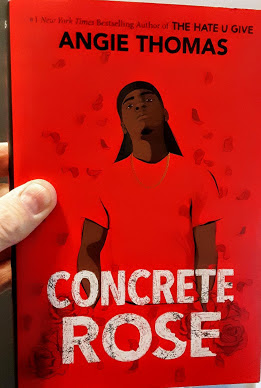
Book Review: Concrete Rose

 Concrete Rose, by Angie Thomas


    We already know Maverick Carter is good man. Now we know why he is a good man.

    Angie Thomas' third novel is a prequel of sorts, set 17 years before the time of her debut novel, The Hate U Give. It's a welcome, well-written dive into the backstories of her characters, particularly the father of Starr Carter. This new book shows his growing up amidst the poverty of Garden Heights. 

    It's intriguing to see Thomas focus on the lives of young Black men, such as Maverick Carter. Her previous novels have centered on Black girls and their trials of growing up, and while that's important, it's good to hear her voice focusing on the problems of boys.

    Her story centers on Maverick when he is a senior in high school, a part of his community, and tied up in the King Lords gang. He reluctantly slings drugs -- sometimes behind the backs of the gang leaders -- while his father, a former gang leader, sits in a state prison for life.

    This is Carter's story. He is the protagonist and narrator, and we are privileged to hear his thoughts and feel his frustrations, his fears, and his joys, as he goes about his teen-age life.  

    He's basically a happy kid. He wants to hang out with his friends and cousins and make a little money to help out his hard-working but poor mother. Thomas shows how he navigates the complicated lifestyle in the 'hood. While he is faulted for some of his choices, we see how some in the community recognize his potential and help and encourage him to get there.

    We already know his future, but it is nice to see it evolve.

     The novel is a fine introduction to a part of the Black community. Thomas, a Black woman from Mississippi, is a great tour guide, weaving us through the hard times, the feelings of being trapped, but also the joys and heartbreaks of home, family, and friends.


January 17, 2021

Book Review Shuggie Bain

 Shuggie Bain, by Douglas Stuart


    Shuggie leads a sad and depressing life. 

    So does his alcoholic mother, his cheating, abusive father, his sister, and his lost-soul older brother. Indeed, this novel is full of sad and depressing people, words which also describe this ultimately disappointing book.

    None of the characters is a good person. Except for his siblings, who are minor players, you cannot root for any of them -- even Shuggie, a child who is bullied and struggling with the perception that he is not like other boys. But his character has little life of his own; although he appears to be the novel's protagonist, he seems more of a supporting character meant to showcase the fears and faults of others. 

    The child ignores reality and keeps believing his mother will eventually recover from her disease. His love for her is rarely reciprocated -- and when it is, never for very long.

    What also makes this book disappointing is that it is the 2020 winner of the Booker Prize. Usually, even being longlisted for the prize is a good sign that it's a book worthy of your reading list. This is the first time I have found that not to be the case.

    Set in Glasgow, Scotland during the 1980s, the  novel shows the changing economy of the times, as working class jobs dry up, and people fall into poverty and despair. Shuggie is a young boy growing up with the slow realization that he is gay in a paternalistic, macho culture. His mother is a self-absorbed drunk seldom available for him. His abusive father has mostly abandoned the family. Shuggie, bullied at school, alone at home, struggles to survive.

    On a positive note, the book is well written and pulls you in. But it never hits a satisfying point.

    It doesn't follow Shuggie's inner struggles and turmoil. Rather, it emphasizes the bigotry and hatred he is subjected to on a more-or-less daily basis.

    Such bitter neighbors and schoolmates are the novel's focus -- and the downtrodden working class community Shuggis is a part of is not treated with kindness or sympathy. Their poverty and despair may come from a changing economy that considers them castaways -- this is the era of Reagan and Thatcher, after all -- but the author fails to connect them to this larger social decline

    Instead, their poverty, malice, and despair are shows as their own fault. From pilfering coins from gas meters, to stealing whatever is nearby, to using others for their own gain, the characters are portrayed as without morals.